


Asphalt for Pickleball Court: Cost, Thickness, and Lifespan
You can almost hear it—the clean thwack of a game-winning shot echoing across your own court. But before surface colors, nets, or fencing come into play, the most important decision happens below the surface. An Asphalt for Pickleball Court foundation determines whether your court performs flawlessly for decades or develops cracks and puddles after only a few seasons.
According to experienced court builders, asphalt quality and installation precision are what separate a professional-grade court from a costly disappointment. Understanding realistic costs, correct thickness, and long-term lifespan allows you to budget properly and protect your investment from the start.

Asphalt for Pickleball Court Cost and Budget Expectations
The cost of an asphalt pickleball court base is often underestimated because the most important work is hidden underground. For a professionally installed asphalt base—including excavation and stone foundation—most projects fall between $5 and $10 per square foot.
This price reflects the structural foundation only and does not include fencing, lighting, or acrylic surfacing. Where your project lands within this range depends on several site-specific factors.
Cost Factors That Matter Most
The first major cost variable is site preparation. A flat, open area requires far less labor than a sloped yard with trees, roots, or poor soil conditions. Excavation, grading, and debris removal can quickly influence the final price.
Next is the depth of the stone sub-base. Soil type and climate determine how much crushed stone is needed to create a stable foundation. Regions with sandy or expansive soils typically require deeper bases for long-term performance.
Finally, site access plays a major role. If heavy equipment can easily reach the build area, costs remain lower. Tight access that requires smaller machines or hand work increases labor time. Contractors such as Ace Coatings South Florida routinely evaluate these factors upfront to provide accurate, transparent estimates.
Asphalt for Pickleball Court Foundation and Thickness Requirements
The asphalt layer itself is only as good as what supports it. A court’s longevity depends on proper sub-base construction and precise asphalt thickness.
Sub-Base Construction Standards
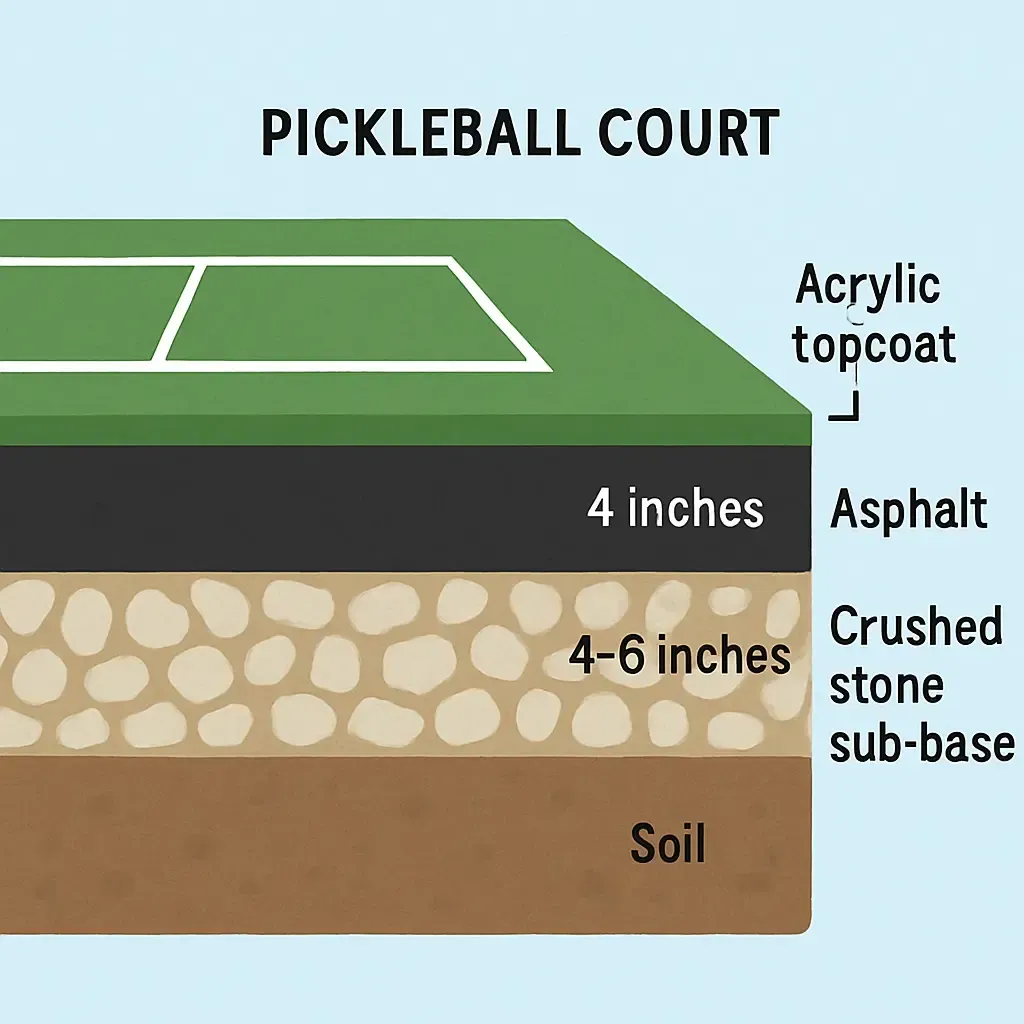
The true foundation of any asphalt court is the crushed stone sub-base beneath it. This layer must be at least 4 to 6 inches deep, made from angular crushed stone that locks together when compacted.
The sub-base serves two essential purposes: structural stability and drainage. Water must be able to escape from beneath the court to prevent freeze-thaw damage. Without proper drainage, trapped moisture expands and contracts, eventually cracking the asphalt above.
Professional contractors compact the sub-base mechanically until it becomes rigid and unmoving. This step cannot be skipped or rushed. Teams like Ace Coatings South Florida emphasize that nearly all premature court failures trace back to improper sub-base preparation.
Thickness Specifications
Once the sub-base is complete, asphalt is installed on top. While residential driveways often use only 2 to 3 inches of asphalt, pickleball courts require 4 inches of compacted asphalt to handle repeated play and environmental stress.
It’s important to understand that asphalt is laid thicker than its final depth. Hot asphalt contains air and compresses under heavy rollers. An initial thickness of roughly 5 inches is typically required to achieve a finished, compacted depth of 4 inches.
Your contract should clearly specify “4 inches compacted thickness.” Without this wording, some contractors may deliver less structural strength than expected, increasing the risk of cracking and water pooling.
Asphalt for Pickleball Court Lifespan and Long-Term Value
When properly built, an asphalt pickleball court is a durable, long-term investment that balances performance and cost effectively.
Durability and Climate Performance
One of the key advantages of asphalt is flexibility. In regions with temperature changes or freeze-thaw cycles, asphalt can move slightly with the ground rather than cracking immediately. This makes it particularly effective for outdoor courts.
Industry guidance aligned with USA Pickleball standards emphasizes consistent slope, proper base depth, and surface maintenance to maximize lifespan. When these elements are executed correctly, asphalt bases routinely last 20 to 30 years.
Maintenance and Resurfacing Cycles
While the asphalt base lasts decades, the acrylic playing surface on top wears out faster. Most courts require resurfacing every 5 to 8 years, depending on use and exposure to sunlight.
Between resurfacing cycles, crack monitoring is critical. Small cracks should be repaired promptly to prevent water intrusion. Left untreated, moisture can penetrate the base, freeze, expand, and cause significant structural damage.
Facility owners who work with experienced providers like Ace Coatings South Florida often benefit from long-term maintenance planning that protects both performance and budget.
Asphalt vs. Concrete: Choosing the Right Base
Asphalt and concrete both have a place in pickleball construction. Asphalt generally offers lower upfront cost and better flexibility in changing climates. Concrete provides rigidity but is more prone to cracking unless upgraded to post-tensioned systems.
For most residential and recreational courts, a properly built asphalt base offers the best balance of affordability, durability, and performance.
Your Contractor Checklist Before You Build
Before hiring a contractor, ask these essential questions:
How deep will the sub-base be and how will it be compacted?
What is the final compacted asphalt thickness?
How will proper slope and drainage be ensured?
Will the estimate be broken down by construction phase?
What sports court projects can you show as references?
Clear answers indicate real expertise—not guesswork.
Build Once, Play for Decades
An asphalt pickleball court built correctly delivers consistent bounce, safe footing, and long-term value. Cutting corners at the foundation stage almost always leads to costly repairs later.
Choosing experienced specialists who understand court-specific construction—such as Ace Coatings South Florida—helps ensure your court performs the way it should from the first serve to the thousandth game.
Contact us at Ace Coatings South Florida to learn how professional asphalt court construction can provide a reliable, long-lasting foundation for years of pickleball enjoyment.
